
Architecture case study
Controlled Chaos
A cellular-automata study testing how simple growth rules can generate, constrain and environmentally tune architectural aggregates.
Project type
Computational architecture and generative growth
Portfolio status
Architectural computation workshop project
Location
Bartlett School of Architecture, London
Project overview
Rule-based growth becomes an architectural design material.
The project varies cellular growth parameters to observe how three-dimensional aggregates emerge. The resulting formations are then interpreted as clusters of inhabitable inserts rather than treated only as abstract geometry.
Environmental obstacles, including existing trees, introduce site-specific limits to the growth field. A further optimisation stage compares solar exposure, adding a second layer of control to a process that remains generative rather than fully predetermined.
Design priorities
Three ideas carried through the proposal.
01
Simple local rules generate complex spatial aggregates.
02
Contextual obstacles redirect growth and preserve site conditions.
03
Solar evaluation helps compare generated outcomes without fixing one form too early.
Portfolio boards
Concept, analysis and design development.
Selected original boards from the reviewed portfolio source.
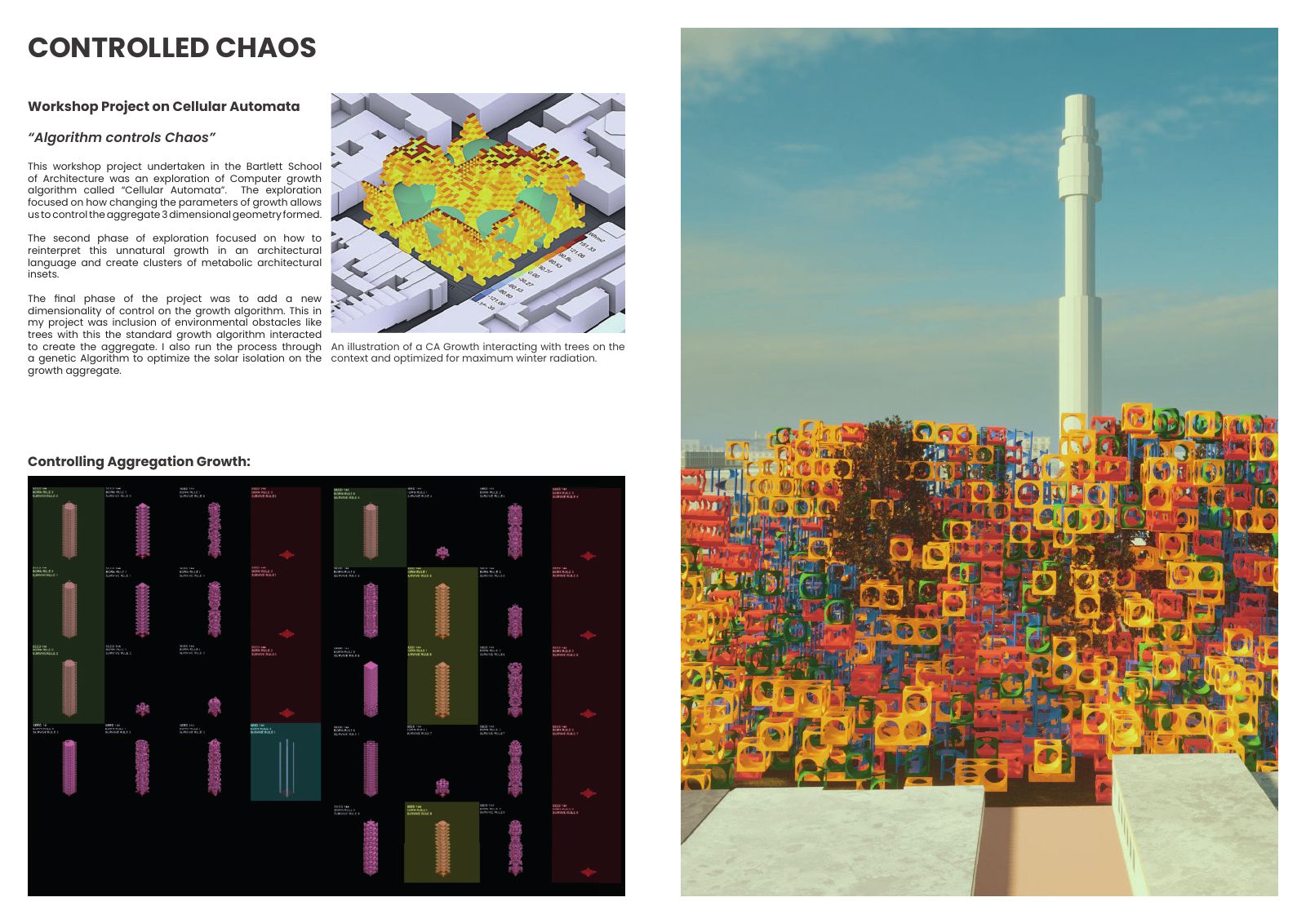
Cellular-automata growth study, context constraints and final aggregate.
Next step
Bring the next project into focus.
Share the site, ambition and current stage. We will identify the design questions that need to be resolved next.